Who Are We?
The National Archives were created during the French Revolution to preserve the records of the central State. Today, they are the largest archival centre in Europe, and they are planning for the growth of their holdings and collections at least through 2050.
History of the National Archives
12 September 1790: the National Archives were established during the French Revolution. By decree, the National Assembly entrusted them with the role of “repository for all acts establishing the constitution of the kingdom, its public law, its legislation, and its division into départements.”
Four years later, the Convention clarified their mission by the law of 7 Messidor Year II (25 June 1794), drafted by the deputy of the Third Estate, Armand-Gaston Camus.
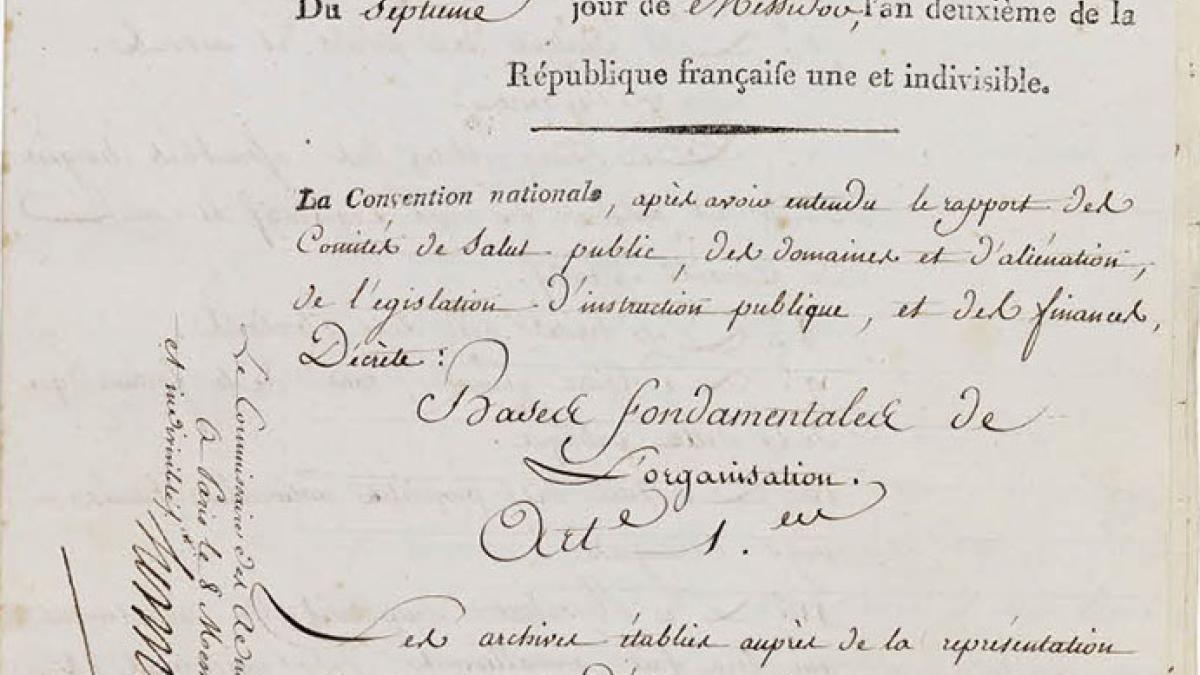
Three major principles that still apply today:
- the centralisation of the Nation’s central archives;
- free access for all citizens;
- the establishment of a national archival network.
The law of 5 Brumaire Year V (26 October 1796) established an archival service in every département capital.
What Records Are Collected?
At their origin, the institution collected:
- the archives of central institutions abolished by the Revolution;
- the records of the ecclesiastical establishments (bishopric, parishes, convents) of the Diocese of Paris;
- seized archives belonging to emigrants or condemned individuals.
In the 19th century, the National Archives—based at the Hôtel de Soubise in Paris—began to collect ministry archives. Expanded into the Hôtel de Rohan, they also began acquiring the minutes of Parisian notaries in 1927.
After the Second World War, new collecting fields emerged: personal and family archives, as well as corporate archives.
Faced with saturation at the Paris site, the “City of Contemporary Archives” opened in the early 1970s in Fontainebleau, where expertise in electronic records was developed.
Did you know?
The Archives Museum, located in the Hôtel de Soubise, opened in 1867.
Its mission: to present to the public the most remarkable documents held by the National Archives.
An Institution Serving Citizens
Today, the National Archives are a public institution under the Ministry of Culture.
As the memory of France, they continue to preserve and make available to the public the archives of the State from the Middle Ages to the present (except those of the Ministry for Europe and Foreign Affairs, the Ministry of the Armed Forces, and the economic and financial ministries), the archives of Parisian notaries, and private archives of national interest.
They contribute to historical knowledge and the transmission of civic values among the general public—especially young people—through exhibitions, publications, and various outreach activities.
And Tomorrow?
As the Paris site became insufficient, the State chose, in 2004, the city of Pierrefitte-sur-Seine (Seine-Saint-Denis) to host a new building. The Fontainebleau site closed in 2014.
The Italian architect Massimiliano Fuksas designed this new centre, inaugurated in 2013. This repository provides 380 linear kilometres of storage capacity. However, this vast building will reach saturation in 2027.
Expansion of the Pierrefitte Site
In addition to the ever-growing volume of digitally born archives, the National Archives receive several kilometres of paper records every year… Not to mention the transfer of more than 70 km of archives from the Fontainebleau site (Seine-et-Marne), which the National Archives closed in 2022.
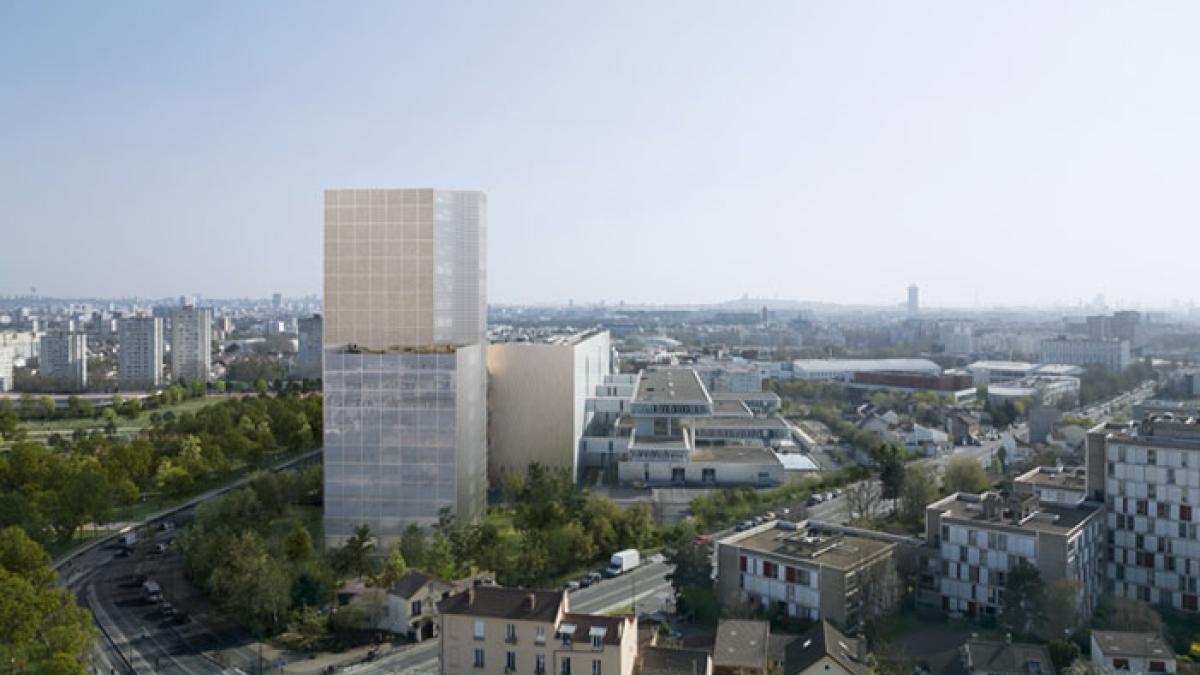
Planned since the initial project, the extension of the Pierrefitte-sur-Seine site—designed by the AUC architectural agency—will increase its capacity by an additional 100 linear kilometres. This new building will accommodate new archives at least until 2050. It will also improve the site’s functionality by providing new spaces for processing, conservation, and reproduction of documents.
The extension will integrate environmental considerations into its construction methods and aim to reduce land use in order to preserve green spaces, in continuity with the development initiatives undertaken by stakeholders in the Zac des Tartres area.
Construction is scheduled to begin at the end of 2024, with completion expected at the end of 2027.