
The Library: a Historic Place and Collections
The National Archives Library was established in the 19th century at the initiative of Pierre Daunou, Keeper General of the Archives. Created to support the research work of archivists, it holds rich collections comprising more than 150,000 volumes and 2,000 periodicals.
Today, it is a remarkable heritage site, both for researchers and visitors, distinguished by its collections and its historic furnishings.
The Origins of the National Archives Library
The law of 4 March 1796 established a library at the Tuileries Palace for the legislative body. This initiative foreshadowed the intention to equip the National Archives with an effective research facility, providing archivists with a dedicated place for research and access to the printed heritage collections.
Appointed Keeper of the Archives in 1804, Pierre Daunou was unable to acquire this library and incorporate it into the archival collections that began arriving at the Hôtel de Soubise from 1808 onwards. However, he set about rebuilding collections to provide archivists with the resources they needed for their work and made numerous requests for books to be allocated to the Archives.
Key dates in its development
From 1830 to 1840, the library was first housed in the official residence of the Keeper of the Archives. With a collection of 12,000 books, it occupied five rooms.
In 1862, the National Archives acquired the Hôtel de Breteuil, located close to the Hôtel de Soubise. The library moved into this private mansion in 1866, at the same time as the École nationale des chartes.
When the École des chartes moved to the Sorbonne in 1897, the library expanded across two floors. Its shelving, numbered shelves marked in gold paint, worktables and furniture specially designed for large-format books and documents were all carefully conceived to make it as functional as possible.
During the 1830s–1860s, the collections of the historical library were enriched through donations and transfers. They were progressively organised: a thematic classification system was established and the books were entered into the catalogue. Gradually, acquisitions became increasingly focused on the history of France and the fundamental disciplines underpinning historical research.
What can you find in the library?
In 1849, the Historical Library of the National Archives held 14,137 volumes, compared with more than 73,000 in 1947. Today, with more than 150,000 volumes and 2,000 periodicals and journals, it specialises in archival science and history.
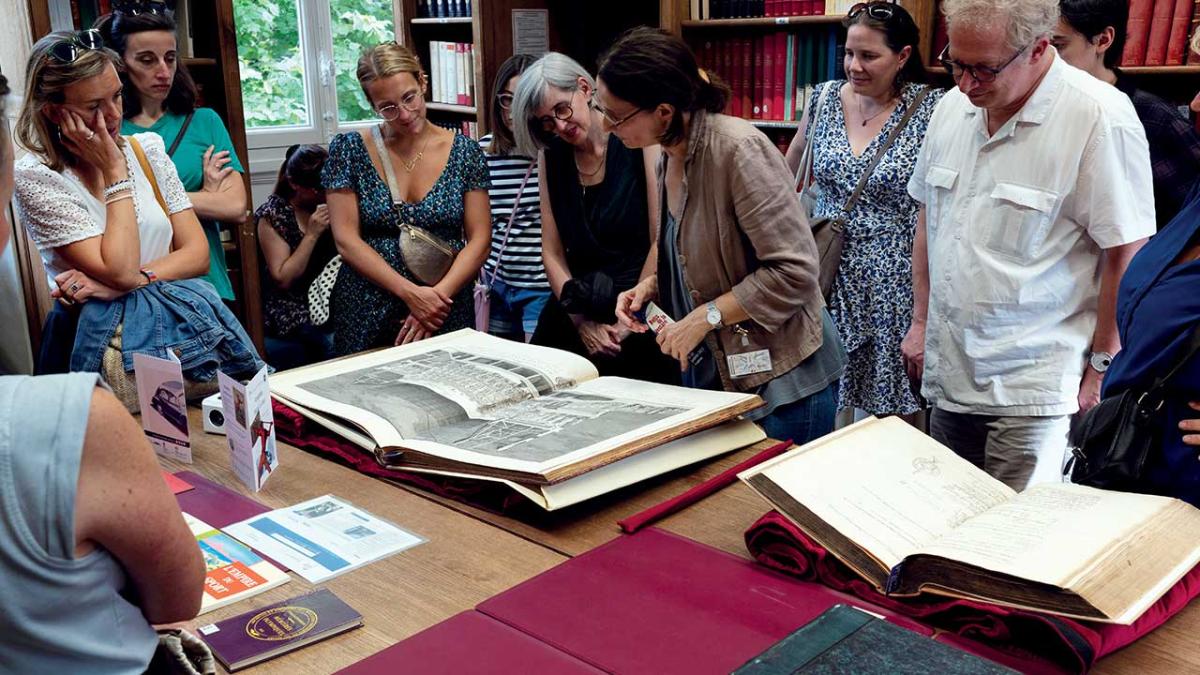
This research library holds numerous rare and historic books that form part of France’s cultural heritage. Some are considered publishing “monuments”, such as the *Description de l’Égypte* and Diderot and d’Alembert’s *Encyclopédie*.
Other books are remarkable for a variety of reasons:
- their age particularly incunabula (books printed before 1501);
- the quality of their illustrations(maps, engravings, lithographs, etc.), particularly in atlases, travel books and works on natural history;
- the quality of their **bindings** (ceremonial books, royal almanacs, etc.);
- their representativeness, including scholarly journals, printed research tools and administrative publications.
Can you visit the library?
The library opens its doors to the general public during cultural events, such as the European Heritage Days and the Reading Nights.
Timeline
1830
The library is being set up in the official residence of the Archives custodian.
1830-1860
Its collections are being enriched through donations and transfers, and are becoming structured
1866
She moved into the Hôtel de Breteuil at the same time as the École nationale des chartes.
1897
It spans two levels, following the departure of the École des Chartes for the Sorbonne.
Aujourd’hui
The library holds more than 150,000 volumes and 2,000 periodicals or journals.