Initial search
Remote Research
By yourself
1. Check the types of records held by the National Archives
It is recommended that you verify whether the National Archives hold the records you are interested in. Some categories of records are held by other archival institutions.
2. Consult thematic research guides in the virtual reading room
Guides explain the method to follow for the most frequently requested topics.
They are grouped into 15 main themes, accessible just below the main search bar on the homepage of the virtual reading room.
3. Consult research guides and inventories
In the virtual reading room, the main search bar on the homepage allows you to search the inventories describing our archives:
- enter one or more search terms;
- refine the results using the filters in the “Refine with more criteria” column.
See “Performing a simple search”.
For more in-depth research, it is essential to first carry out a bibliographic search in a library or documentation center.
More advice
Learn more about:
How to search only for digitized documents available online?
In 3 steps, you should:
- click on the “Digitized archives” tab, located just below the main search bar;
- search the virtual reading room using the methods described above;
- view the thumbnails of the documents that interest you.
To identify the main digitized collections, consult the dataset “Corpus of digitized documents of the National Archives” on the data.gouv.fr platform.
If you need assistance:
- online: you must first create a personal account in the virtual reading room;
- by phone: +33 1 75 47 20 00, during reading room opening days (9:00 am – 4:45 pm);
- by post:
Archives nationales
59, rue Guynemer
Pierrefitte-sur-Seine
93383 Saint-Denis CEDEX
On-site research
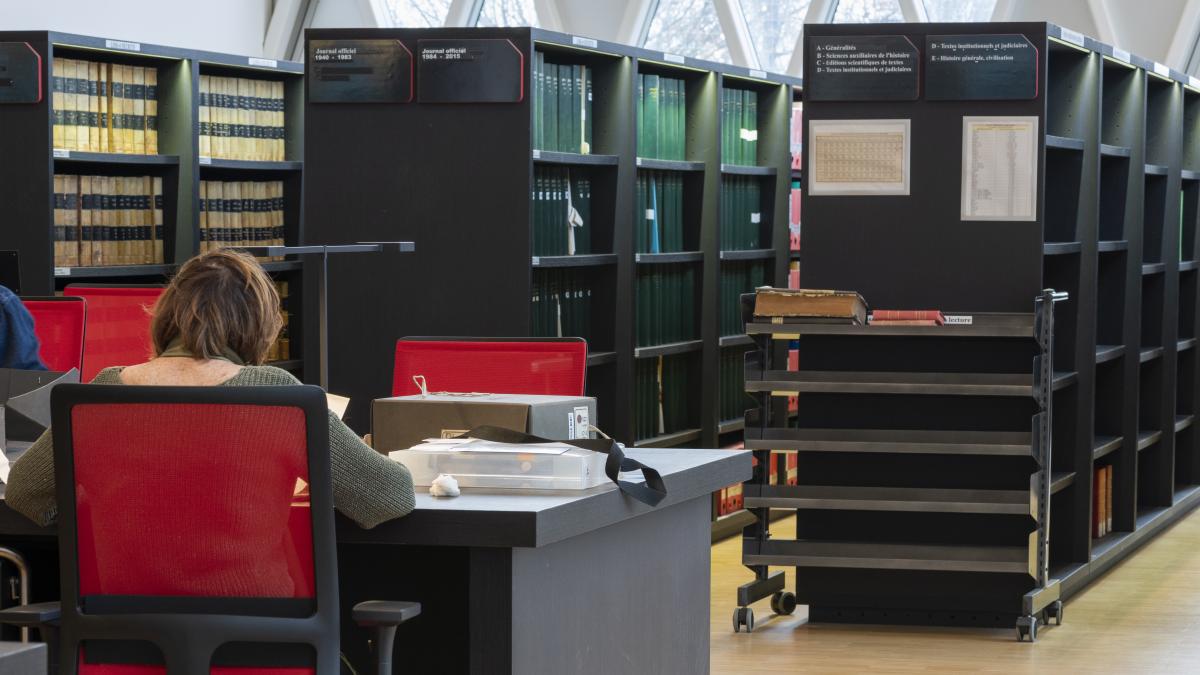
The two National Archives sites, in Paris and in Pierrefitte-sur-Seine, have an on-site inventories room where you can:
- carry out the steps described for remote research yourself;
- receive guidance from specialized staff.