
The largest archives center in Europe
Inaugurated in 2013 by the President of the Republic, the Pierrefitte-sur-Seine site is the largest archives center in Europe. It is built in the heart of the Seine-Saint-Denis department, close to Paris 8 University. This ambitious project demonstrates the State’s intention to position the new site within the development of Greater Paris, emphasizing accessibility and cultural democratization. Its capacity for preservation is more than 350 km of archival shelving, which will be fully occupied by 2027. A project to expand the conservation storage areas is underway.
A site adapted for conservation and scientific research
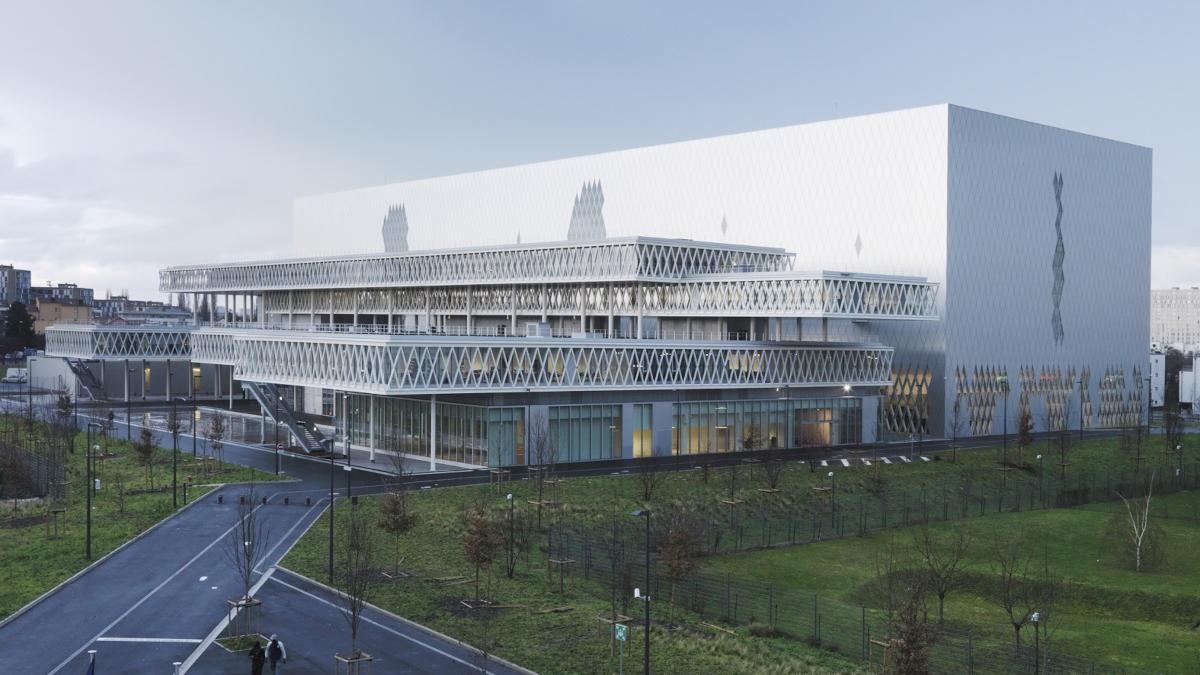
Italian architect Massimiliano Fuksas, internationally renowned (with works in Austria, Germany, Italy, Israel…), designed the Pierrefitte-sur-Seine site with 66,000 m² of usable space and 350 km of archival stores.
The objective is to house the archives of the central State administrations created after the French Revolution.
Inaugurated in 2013 by the President of the Republic, this vast building is the largest archives center in Europe. It offers a scientific environment tailored to conservation and research. As a vault for the Nation’s records, the building is opaque and monumental to protect them, but its democratic ambition also requires that it be easy to access and welcoming to the public.
To achieve this, Massimiliano Fuksas worked with two design polarities:
- a monolithic block of concrete and steel — a vault-like building offering thermal inertia qualities ideal for archival conservation, oriented toward the east and facing the landscape of the new Tartres district;
- glass-walled satellite structures housing offices and public areas, opening onto reflecting pools and capturing changing light.
220
storage warehouses
75 %
of the building dedicated to the preservation of archival documents
325
consultation and research spaces
300
seats in the auditorium
A site integrated into its territory
Located near Paris 8 University, the building fits into the Île-de-France landscape where agricultural traces mix with urban development. Landscape architect Florence Mercier, in collaboration with the architect, designed the site’s garden covering 16,000 m². This work was carried out in coordination with the Plaine Commune teams and the Seine-Saint-Denis department’s urban planning group responsible for the landscaping and urban development of the Tartres. The 5,400 m² of public spaces on the site welcome researchers from around the world coming to consult documents, visitors to exhibitions and the permanent route, as well as audiences of conferences and young visitors, particularly school groups. All benefit from the expertise, scientific influence, and outreach work of the Archives nationales, an institution rooted in its territory and in Greater Paris projects.
An expansion for the future
Following the closure of the Fontainebleau site (Seine-et-Marne), the transfer of 70 km of archival collections was completed in 2022. This significant growth makes it necessary to increase the storage capacity at the Pierrefitte site.
The aim is to accommodate an additional 100 km of archives.
In 2022, the Minister of Culture — on the recommendation of the competition jury convened on June 17 — chose the project by the AUC agency, winner of the 2021 Urban Planning Grand Prix, to carry out the building’s extension. The jury was particularly sensitive to the environmental dimension integrated into the construction processes and the aim of minimizing ground coverage to preserve green spaces, in line with the development projects of the ZAC des Tartres. This vertical extension, built on the site’s reserved land, will include conservation areas, workspaces, and offices. Thus, the site will be able to receive new archival deposits at least until 2050. The extension will also improve site functionality with new treatment, restoration, and document reproduction spaces. A public inquiry was held concerning alignment with the local intercommunal urban plan (PLUi) of Plaine Commune from June 1 to July 3, 2023. The expanded facility is expected to be operational by the end of 2027.
Chronology
2013
Opened to the public
2027
+ 100 km of additional archives storage capacity